
AI Living Room Styles: 9 Looks and How AI Restyles Your Room From a Single Photo
The fastest way to see your couch in a whole new look is no longer a mood board — it’s an AI living room design tool that repaints your actual room in any style from one photo. According to Scandinavian design documentation on Wikipedia, that particular look alone has shaped decades of furniture trends, which hints at how much history sits behind the styles an AI tool now applies in seconds. This guide breaks down the nine living-room styles worth knowing — their traits, palettes, and materials — and shows how AI applies each to your space.

Whether you lean toward the warm woods of Japandi or the shiplap of a modern farmhouse, you’ll learn how to pick a look and which styles AI copies most faithfully.
The 9 Living Room Styles at a Glance
Before diving into details, it helps to see all nine styles side by side. Each one carries its own era, mood, and visual shorthand — some are decades-old movements, others are blends that only recently got a name.
| Style | Vibe in one line | Origin / era |
|---|---|---|
| Modern | Clean, minimal, uncluttered | Ongoing, rooted in 20th-century minimalism |
| Mid-Century Modern | Retro warmth, organic curves | 1945-1969 |
| Modern Farmhouse | Cozy rustic meets crisp white | 2010s revival of American farmhouse |
| Scandinavian | Light, airy, functional | Early-to-mid 20th century, Nordic countries |
| Boho | Layered, collected, eclectic | Rooted in 19th-century bohemianism |
| Traditional | Symmetrical, formal, timeless | 18th-19th century European classics |
| Industrial | Raw, urban, loft-like | 1960s NYC loft conversions of early 20th-century factories |
| Coastal | Breezy, bright, relaxed | Beach-house aesthetic, mid-20th century onward |
| Japandi | Minimal warmth, quiet luxury | 2010s Japan-Scandinavia fusion |
A few things to keep in mind as you read through the style breakdowns below:
- Each section covers the style’s key traits, its color palette, and the materials that define it
- Most sections also note which room types or lifestyles the style suits best
- Palettes and materials repeat across styles in small ways — that overlap is normal and often what makes blended looks (like Scandi-boho) work
- The final tables let you compare all nine styles side by side once you’ve read the details
Modern & Contemporary: Clean Lines, Open Space
Modern and contemporary living rooms favor clean lines, open floor plans, and furniture that stays low-profile and strictly functional. The palette leans neutral — whites, grays, and the occasional black accent — with materials like steel, glass, concrete, and lacquered wood doing most of the visual work.
It’s worth separating “modern” from mid-century modern, since the two get confused constantly. Modern is an ongoing minimalist ethos with no fixed end date; mid-century modern is a specific design movement tied to 1945-1969. A modern living room today might still use glass and steel from 2026, while an MCM piece is, by definition, either from that era or a faithful reproduction of it.
Key traits of a modern living room:
- Uncluttered surfaces with minimal decorative objects
- Low-profile sofas and chairs with clean, unornamented silhouettes
- Neutral base palette punctuated by one or two bold accents
- Materials: steel, glass, polished concrete, high-gloss lacquer
- Open sightlines between the living room and adjacent spaces
Mid-Century Modern: Retro Warmth With Organic Shapes
Mid-century modern design traces back to 1945-1969, and its living rooms still read as distinctly of that era even in a 2026 build. The style blends organic curves with geometric structure — think tapered wooden legs on a sofa paired with a sharply angular credenza.
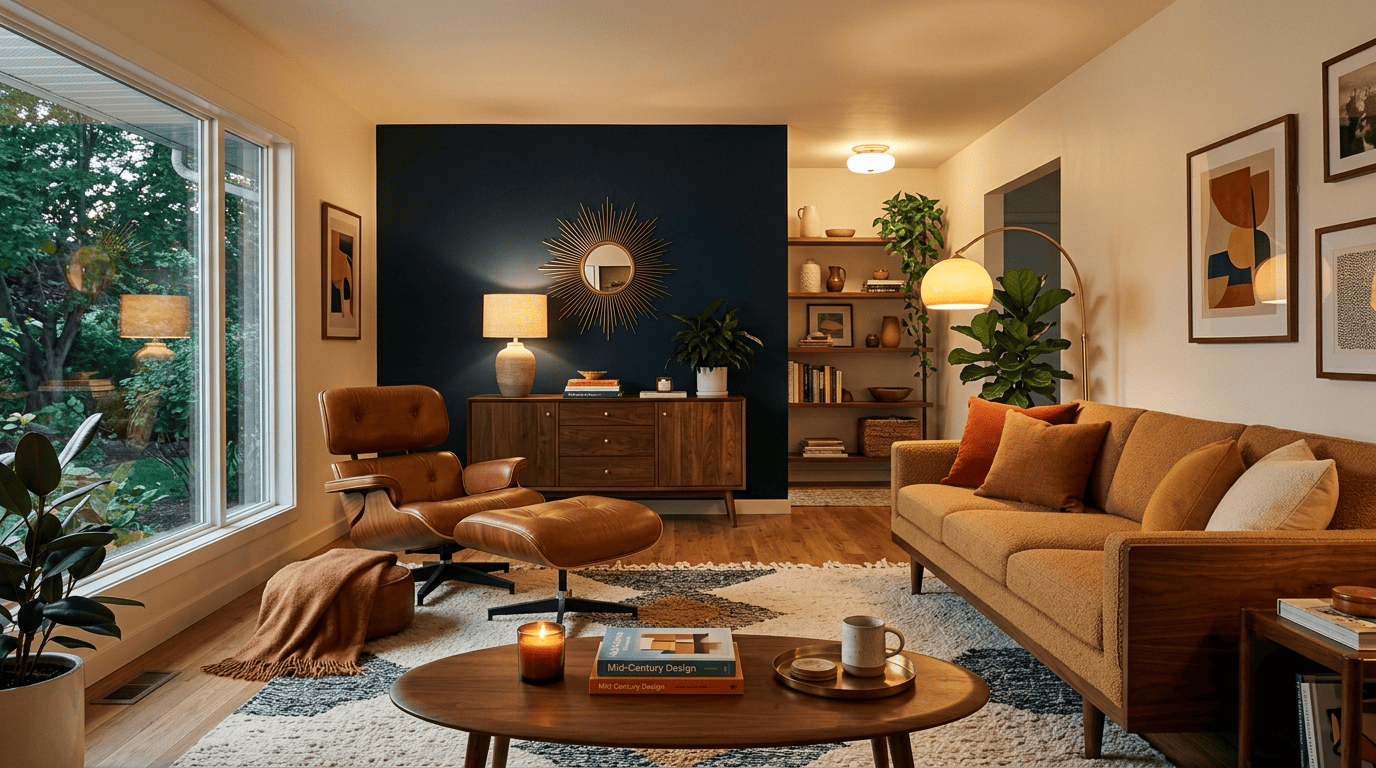
Statement furniture drives the room. An Eames lounge chair, a sunburst mirror, or a walnut credenza with brass hardware can anchor an entire space, letting everything else stay quieter by comparison.
Large windows and warm materials do the rest. Picture windows bring in natural light, while teak and walnut surfaces, tapered legs, and a palette of warm wood tones alongside mustard, olive, and burnt orange keep the room feeling grounded rather than sterile.
Signature elements to look for:
- Organic-plus-geometric shapes in the same piece of furniture
- Tapered, angled legs on chairs, sofas, and tables
- Teak or walnut as the dominant wood tone
- At least one statement piece (lounge chair, sunburst mirror, credenza)
- Large “picture” windows framing the seating area
- Accent colors in mustard, olive, or burnt orange
Modern Farmhouse: Shiplap, Warm Whites, Matte Black
Modern farmhouse living rooms build on warm whites and sage greens as a base, then layer in texture through reclaimed wood beams and wide-plank white oak flooring, typically 7 to 10 inches wide. Shiplap still shows up, but the current approach uses it surgically — one accent wall, not every surface in the room.
Hardware and fixtures lean matte black and brushed brass instead of chrome, which reads as warmer and less clinical. Seating tends toward oversized, overstuffed pieces upholstered in linen, wool, or jute for a lived-in, cozy feel.
Key traits:
- Warm white and sage base palette, moving away from the stark white of earlier farmhouse trends
- Shiplap used as a single accent wall, not a whole-room treatment
- Reclaimed or reclaimed-look wood ceiling beams
- Wide-plank white oak flooring (7-10 inches)
- Matte black and brushed brass hardware, no chrome
- Overstuffed linen, wool, or jute upholstery
The sage-and-cream palette has become something of a signature for the 2026 take on farmhouse style, replacing the cooler grays that dominated the trend a decade earlier.
Scandinavian: Light, Airy, and Deeply Cozy
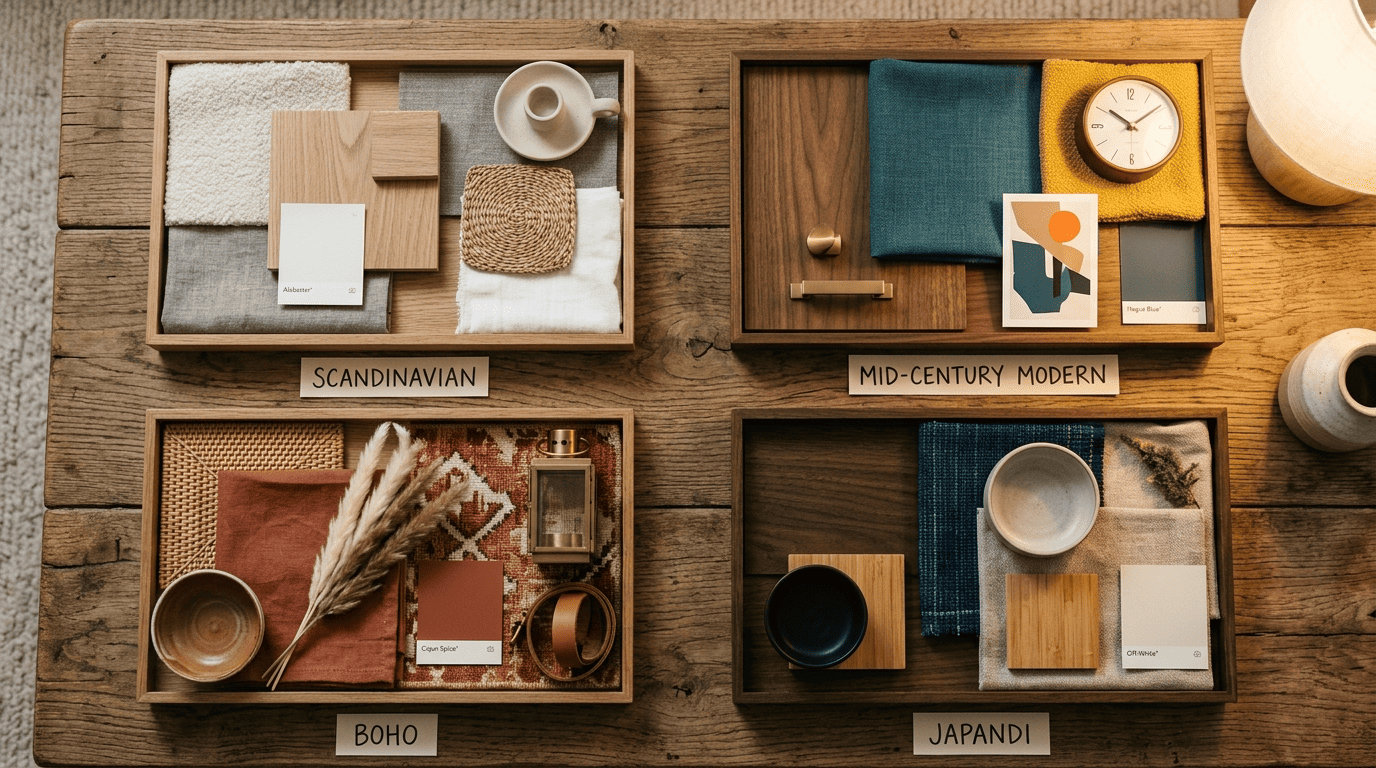
Scandinavian design built its reputation on function first, decoration second — a philosophy that still defines the living rooms built around it today. The palette stays neutral: whites, grays, and soft beiges dominate, with light woods like birch and ash providing warmth without adding visual weight.
Furniture is functional and pared back, often serving more than one purpose in smaller Nordic apartments. Wool and linen textiles — throws, cushions, area rugs — soften all that minimalism, and abundant natural light is treated as a design element in its own right, not just a practical necessity.
The concept of hygge, coziness built through soft textures and warm, low lighting, is central to why Scandinavian rooms feel inviting rather than sparse despite their restraint.
Key traits:
- Neutral white, gray, and beige base palette
- Light woods — birch and ash — as the dominant material
- Functional, multi-purpose furniture with minimal ornamentation
- Wool and linen textiles layered for texture and warmth
- Maximized natural light, often via sheer or no window treatments
- Very few decorative accessories, chosen deliberately rather than in clusters
Boho: Layered, Collected, and Full of Life
Bohemianism as a cultural movement predates the design trend by more than a century, but the living room style it inspired keeps that same spirit of collected, unconventional living. Boho rooms layer textiles, mix patterns freely, and lean on natural materials — rattan, wicker, jute — alongside macramé wall hangings and a generous number of plants.
A useful shorthand for balancing a boho palette is the 60-30-10 rule: roughly 60% cream or neutral as the base, 30% terracotta, mustard, or green as a supporting tone, and 10% saturated jewel colors as accent pops. Vintage and secondhand finds round out the eclectic feel, and warm lighting in the 2700-3000K range keeps the whole space feeling golden rather than clinical.
Key traits:
- Layered textiles — rugs on rugs, mixed cushion patterns
- Rattan, wicker, and jute furniture and accessories
- Macramé and other handmade textile art
- Abundant houseplants, often in varied pot styles
- Vintage or secondhand furniture pieces
- Palette built on the 60-30-10 rule (neutral / earthy / jewel-tone accent)
Boho is eclectic by nature, which means there’s no single “correct” combination — the style tolerates, and even rewards, visual variety that other styles would consider clutter.
Traditional: Timeless, Symmetrical, Layered
Traditional living rooms favor symmetry above almost everything else — matching lamps flanking a sofa, paired armchairs facing each other across a coffee table. Rich, dark woods like mahogany and cherry show up in case goods, while seating takes the form of wingback chairs or rolled-arm sofas upholstered in patterned fabric.
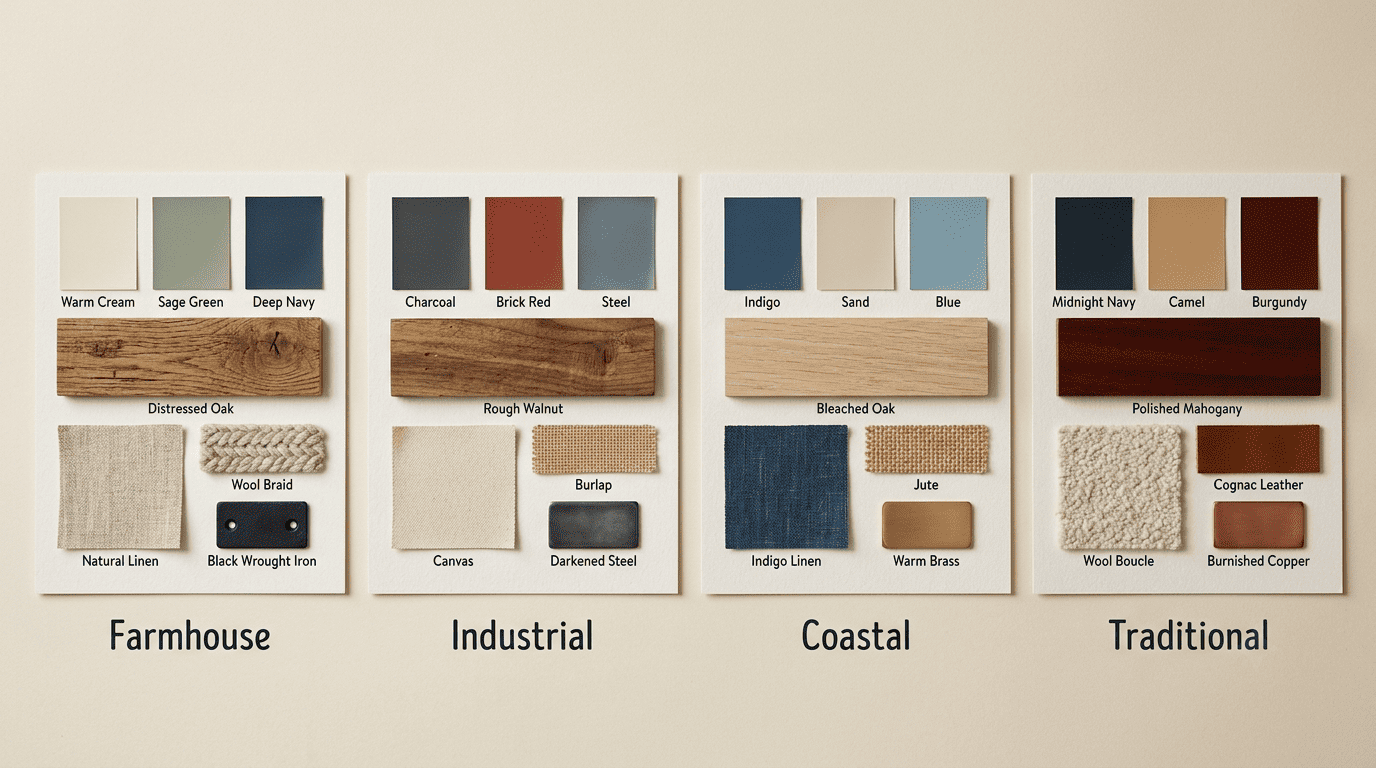
Florals, damask, and plaid are common upholstery choices, and crown molding or other architectural millwork often frames the room. Lighting is layered rather than singular — a central fixture supplemented by table lamps and sometimes sconces — and the palette stays in warm neutrals accented with deep jewel tones like burgundy or forest green.
Key traits:
- Symmetrical furniture arrangement
- Dark, rich wood tones (mahogany, cherry, walnut)
- Wingback or rolled-arm seating
- Patterned upholstery — florals, damask, or plaid
- Crown molding and other classical millwork
- Layered lighting across multiple fixtures
- Warm neutral base with deep jewel-tone accents
Industrial: Raw Materials, Urban Loft Energy
Industrial living rooms borrow directly from the loft conversions that turned early 20th-century factory and warehouse spaces — exposed brick, visible ductwork, and structural metal left intentionally unfinished. Concrete floors or accent walls pair with reclaimed wood for furniture and shelving, and the whole aesthetic depends on high ceilings and large windows to keep the raw materials from feeling heavy.
Edison-bulb fixtures with exposed filaments are close to a signature of the style, and seating tends toward leather paired with steel-framed furniture. The palette stays muted throughout — grays, browns, and black — letting the textures of brick and metal carry the visual interest instead of color.
Key traits:
- Exposed brick walls, left unpainted or lightly sealed
- Visible metal structure — beams, pipes, ductwork
- Concrete floors or accent surfaces
- Reclaimed wood furniture and shelving
- High ceilings and oversized windows
- Edison-bulb or exposed-filament lighting
- Leather-and-steel furniture in a gray/brown/black palette
Coastal: Breezy, Bright, and Relaxed
Coastal living rooms build their identity around a white-and-blue palette that instantly reads as beach-adjacent, even in a room nowhere near the water. Driftwood and other light woods bring in natural texture, while linen and cotton textiles keep the whole space feeling breathable rather than heavy.
Natural light is treated as essential, often maximized with sheer curtains or none at all, and rattan furniture pairs naturally with nautical or organic accents — a piece of coral, a woven basket, a rope-wrapped mirror. The overall effect aims for relaxed rather than themed; a well-done coastal room shouldn’t feel like a beach-house cliché.
Key traits:
- White-and-blue base palette
- Driftwood and light-toned woods
- Linen and cotton upholstery and drapery
- Maximized natural light
- Rattan furniture and woven accessories
- Nautical or organic accent pieces used sparingly
Japandi: Japanese Minimalism Meets Scandinavian Warmth
Japandi is the most recent style on this list, and it’s built on blending two design philosophies rather than reviving a single historical movement. Japanese minimalism contributes wabi-sabi — the idea of finding beauty in imperfection and impermanence — while Scandinavian design contributes hygge, that same coziness-through-texture concept covered above.
The combination shows up as natural woods like oak, ash, and bamboo, often left with visible grain rather than heavily finished. Brass and bronze hardware is chosen specifically for its patina, meaning it’s expected to darken and change with age rather than staying polished. Furniture sits low-profile, and negative space is treated as a design feature, not empty space waiting to be filled.
The palette runs off-white, cream, and stone gray as a base, with sage, clay, and charcoal as supporting tones — and diffused, soft light is preferred over harsh direct sun.
Key traits:
- Blend of wabi-sabi (Japanese) and hygge (Scandinavian) philosophies
- Natural woods with visible grain: oak, ash, bamboo
- Brass or bronze hardware chosen for patina, not polish
- Low-profile furniture silhouettes
- Deliberate negative space
- Palette of off-white, cream, stone gray, sage, clay, and charcoal
- Diffused rather than direct lighting
Style-by-Style: Palettes and Materials
With all nine styles covered individually, this table works as a quick reference for comparing palettes, materials, and ideal use cases side by side.
| Style | Signature palette | Key materials | Best for |
|---|---|---|---|
| Modern | White, gray, black accents | Steel, glass, concrete, lacquer | Open-plan, low-maintenance spaces |
| Mid-Century Modern | Warm wood, mustard, olive, burnt orange | Teak, walnut, brass | Statement-piece lovers |
| Modern Farmhouse | Warm white, sage | White oak, reclaimed wood, matte black | Cozy family rooms |
| Scandinavian | White, gray, beige | Birch, ash, wool, linen | Small or low-light rooms |
| Boho | Cream, terracotta, jewel accents | Rattan, jute, macramé | Eclectic, personal spaces |
| Traditional | Warm neutrals, deep jewel accents | Mahogany, cherry, patterned fabric | Formal living rooms |
| Industrial | Gray, brown, black | Brick, metal, concrete, leather | Lofts and open warehouses |
| Coastal | White, blue | Driftwood, rattan, linen, cotton | Bright, breezy spaces |
| Japandi | Off-white, sage, clay, charcoal | Oak, ash, bamboo, patina brass | Calm, minimal spaces |
How AI Applies a Style to Your Living Room
An AI room-design tool doesn’t just paste furniture over your photo — it reads the actual architecture of your space before applying anything. As Charles Eames, whose lounge chair remains a cornerstone of mid-century modern design, is often quoted as saying:
The details are not the details. They make the design.
Charles Eames
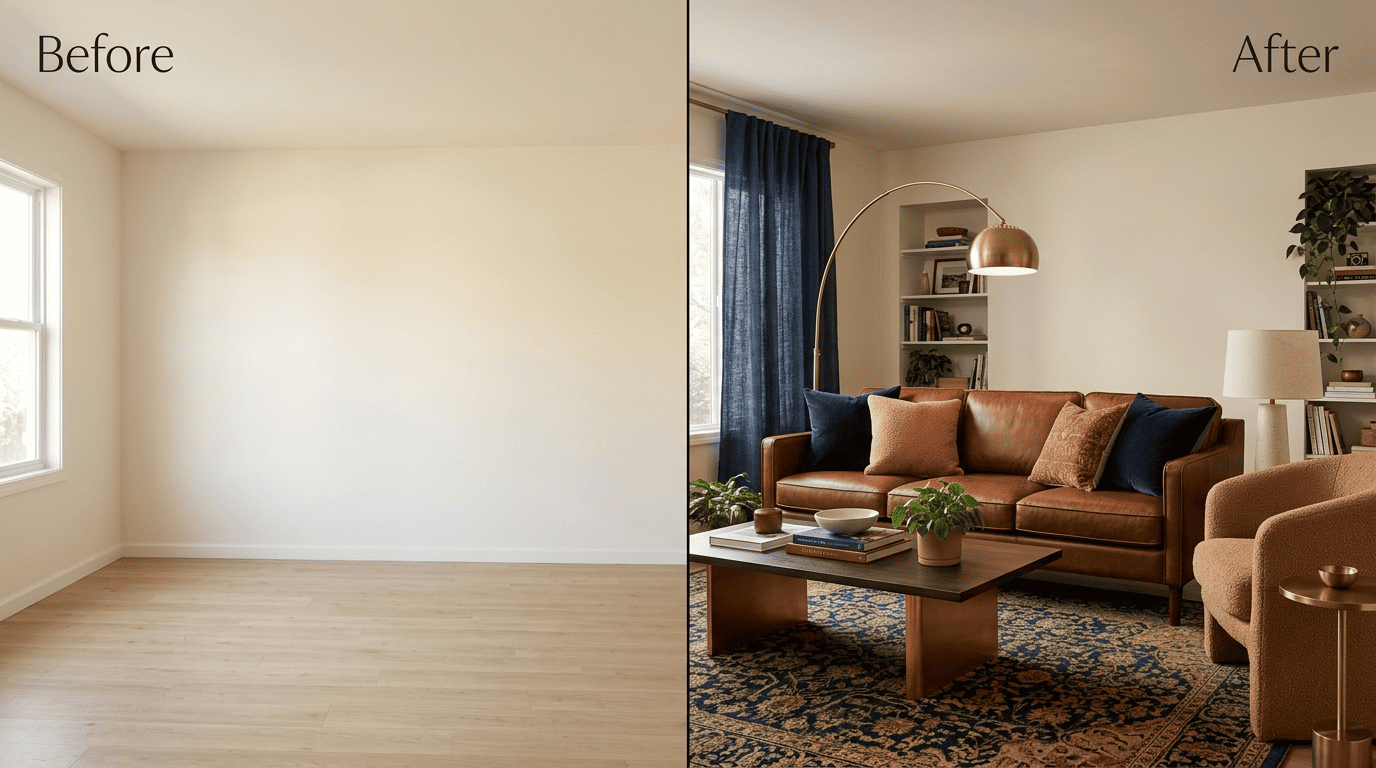
That principle is essentially what computer vision does inside an AI style-transfer pipeline: it identifies the details of your room — window placement, door frames, ceiling height, existing layout — and preserves them while swapping in new furniture, colors, and textures. Try the AI living room design tool with a few different styles to see how consistently it holds onto your room’s actual shape.

How the process typically works, step by step:
- Upload a photo of your living room, taken with reasonably even lighting
- The tool’s computer vision reads the room’s architecture — walls, windows, doors, and overall layout
- You select a target style, such as Japandi or modern farmhouse
- Style transfer applies that style’s palette, materials, and furniture shapes to your specific room
- A photorealistic render generates in roughly 30 seconds, keeping your actual room shape intact
Most people run 8 to 15 iterations before landing on a version they like, adjusting the style prompt or trying a different look entirely between renders. Compared to a human interior designer, who typically charges $2,000 to $8,000 per room, AI tools usually range from free to about $30 a month — a difference that makes experimenting with multiple styles far less risky.
Which Styles Does AI Copy Best?
Not every style renders with the same accuracy, and the difference comes down to how structured or eclectic the source style is. Clean, rule-based styles give the AI clearer patterns to reproduce, while eclectic styles depend on countless small, seemingly random choices that are harder to generalize from training data.
| Fidelity | Styles | Why |
|---|---|---|
| High | Scandinavian, Mid-Century Modern, Japandi, Industrial, Modern | Consistent rules, limited palette, repeatable shapes |
| Moderate | Boho, Traditional | Eclectic mixing, more variables, often needs extra iterations |
If a first render of a boho or traditional room doesn’t quite land, that’s typical rather than a sign the tool is malfunctioning — running a couple of extra iterations with more specific style cues usually closes the gap.
How to Pick Your Living Room Style
Choosing a style doesn’t have to mean committing blind. A short checklist can narrow nine options down to two or three worth actually testing:
- Start from what you already own — a full teardown is rarely necessary, and most styles can absorb a few existing pieces
- Match the room’s natural light — Scandinavian and coastal lean on abundant light, while industrial and traditional tolerate dimmer rooms better
- Consider the room’s actual size — boho’s layered look needs more square footage to avoid feeling cramped, while modern and Japandi work well in tighter spaces
- Pick a palette before furniture — settling on colors first makes every other decision faster
- Test 2-3 styles with AI before committing to any purchase, since a render costs nothing compared to buying the wrong sofa
Once you’ve narrowed things down, it’s worth trying to design your living room with AI across a couple of finalists side by side — seeing your actual room in both looks tends to make the decision obvious in a way swatches and mood boards rarely do.